WHEN THE FIELD OPENS
the risk and reward of beltane season

Hello everyone! This is the first essay of Wild Ecologies - a place to deepen in relationship with the natural world through animism, ecology, and place-based spirit work. Each month will have a free essay on the theme of what is happening bioregionally, and I hope you enjoy.
This time of year holds something different for us.
The low hum of insects returns, signaling aliveness after a long winter of dormancy. Still irregular in nature - not like the booming symphony we receive in the height of summer - but here nonetheless. A reminder of the busyness of community returning.
The air feels more alive, the vastness of winter quiet opening to something bustling in the space around us. Sound, heat, electricity - they all gather to hold us in the transition. Coaxing us to come out and play, to soften into what awaits beyond the membrane of our home.
What does it mean to open? To step into new activity, new possibility, new experience?
FLOWERS AS INVITATIONS TO INTERFACE WITH THE BELOVED
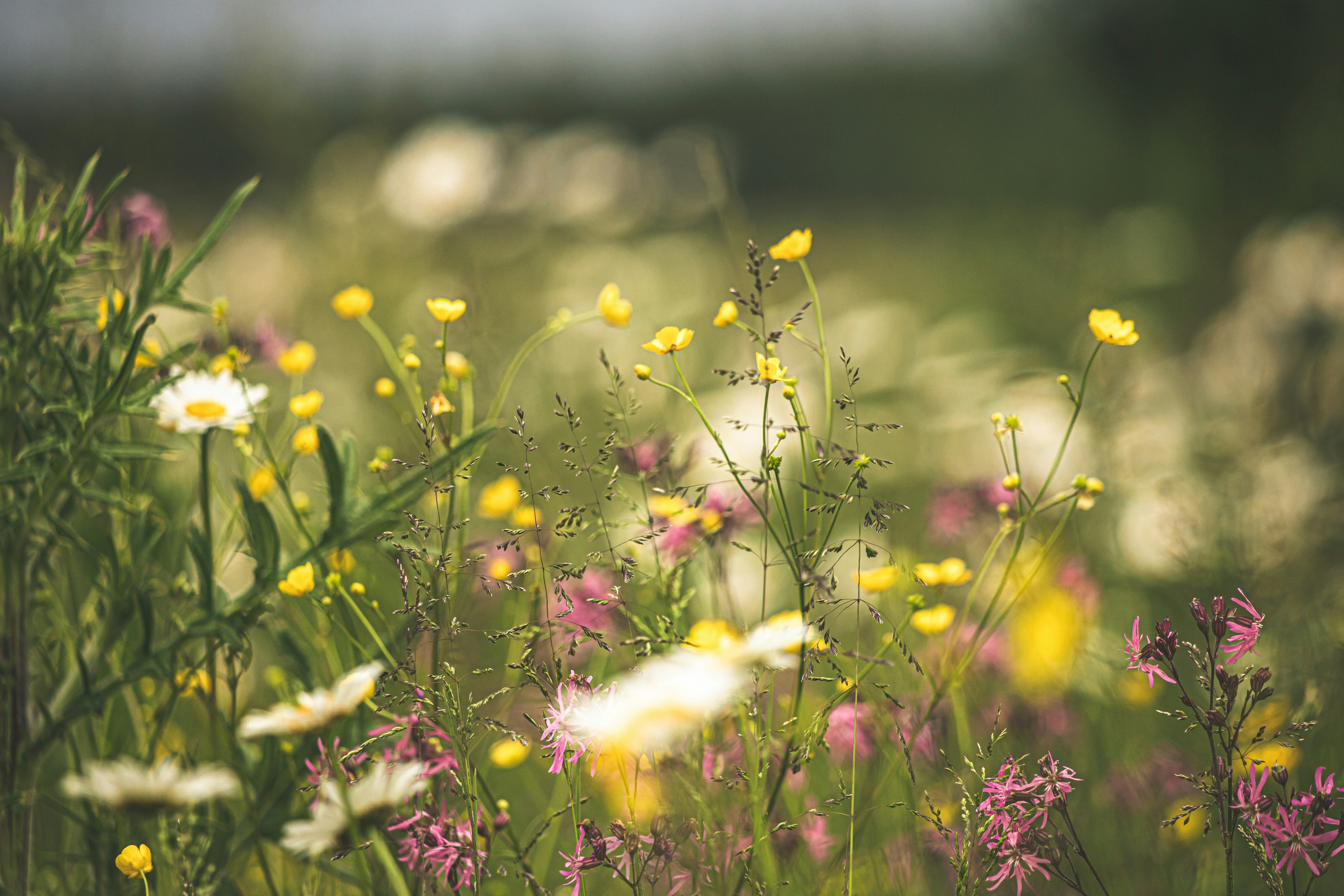
Flowers are an essential place in the web of reciprocity-based survival. Flowers aren’t simply aesthetic structures for our enjoyment, they are designed for intimate contact. They are built to hold bids for attention, affection, and interchange. Inherently and brilliantly designed to be meeting places for desire.
Color: the specific color of flowers signal specific pollinators. Blues, purples, and yellows for bees. Reds and oranges for hummingbirds. Whites or pastels for moths. Each color a song to bring in their suitor.
Scent: On warm air, scent expands outwards in gradients. This creates invisible trails that extend beyond the plant itself. We cannot see how far and wide these gradients reach (jasmine for example has a gradient of 10-50 feet, whereas the corpse flower has a gradient of up to a mile away!), but if we take a step back, we can imagine the paths that scent creates for the relationship between lover and beloved.
Shape: This determines access - the structure filtering participation in the process of reception. A long-throated flower excludes short-tongued insects. A downward-facing bloom limits who can approach them. A dense cluster of stamens forces a pollinator to brush up against reproductive structures while they feed. No shape is arbitrary, the design acts as a funnel for who is meant to commune.
Nectar: Nectar is not a free gift. It is a substance produced at a high cost - sugars pulled from the reserves of the plant, concentrated and placed where they can be taken. When a bee feeds, it is participating in an open loop of reciprocity - one that might not fully complete. Pollen adheres to the body and is carried elsewhere, sometimes lost entirely. This relationship relies on repeated attempts at connection, the constant showing up for the thing we feed that feeds us.
THE FIELD AS A CROSSING
We think of that one bee, that one flower as if it were in a vacuum. But this is not an isolated event - this is happening everywhere, all at once.
The field is active beyond what can be perceived by the human eye. What seemed singular is actually continuous, we are only catching fragments.
Insect movement: irregular flight paths are occurring everywhere. Looping, doubling back, abandoning flowers entirely. Insects don’t only stick to efficient routes, they are constantly experimenting with chaos in their crossings.
Pollen movement: pollen becomes carried beyond the exchange. From the visible dust in the air, to the settling on surfaces not intended, pollen crosses many boundaries. The human who inhales and brings it into their own body, the pollen resting on cars, on backpacks, on leaves and pets and everything that passes through the ecosystem.
Wind movement: trajectories of crossings are altered by the unstable nature of wind. Stillness stops pollination in its tracks, while gusts of wind take the nectar to places previously unimaginable. Motion emerges from within and without - sometimes without logic or reason.
Timescales overlap. Some flowers are just opening to the world, hungry and eager for connection. Others are exhausted of their resources and are in need of rest before connecting with new lovers. Some are already complete in their pollination process - already closing or fading away.
Not everything is synchronized in nature. The field holds multiple phases at once. This is another reminder that time isn’t uniform across beings - each participant in the dance moves at the pace of their own clock.
The field is saturated but not organized. Many interactions are happening in close proximity. There is no visible hierarchy in many of these relational playgrounds - no central coordination occurring, but rather multiple insects on the same plant competing for the attention of the flower. Some plants heavily visited and some hardly touched at all. The field contains it all - clusters of activity and areas of stillness.
THE FIELD AS A NETWORK WITHOUT A CENTER
In the realm of radical possibility, when we are thinking of structures for our future that don’t require oppression from a central authority, the field is a model for what might be on its way.
There is no single organism directing the activity in the field. No central point of coordination, no overseeing structure making sure everyone is doing what they are told.
Instead, we see a network of diversity in process, desire, and ability. Distributed interaction in ways that overlap. Dependencies that are both singular and interwoven into the wider web of things. Things appear to work together even though nothing is directing the system.
OPENING AS EXPOSURE
Let us return to the flower. The flower is open, visible, scented. Accessible to everything and everyone. And from this place we realize that opening is an exposure.
Participation in the field requires vulnerability and risk.
To produce nectar requires precious sugars from the plant’s reserves. Too produce scent requires expensive chemical output. To maintain the color and structure of petal requires water from the root system. The plant invests resources before the outcome is guaranteed.
An important aspect of opening as exposure is the notion of uncontrolled arrival.
Opening can invite in the wrong participants as well as the right ones. Ineffective visitors, nectar thieves (those who take without transferring pollen), and herbivores or damaging insects are just a few who might take advantage of the tender opening.
The plant can never filter perfectly, just like us. We open and get our hearts broken, and will we open again. Just like the plant, we know that risk is a part of the game for survival. We know that we must try again, show up again, reveal again.
There is no protection, only participation. No organism is shielded from risk. Witholding prevents the relational communion that is required for survival. Through this time of Beltane, when the field opens, we remember what it is to risk heartache and harm. To open to whatever might come our way when we are available for connection. To surrender to uncontrolled arrival, to the unknown, for the hope of something great. For the hope of something more than human.
I hope you enjoyed the first essay of Wild Ecologies! If you want to support this project, please subscribe and know that each month has a paid essay on a resonant thread of the month. In addition, paid subscribers receive a monthly curation of things I’ve been reading/listening/watching that are related to Wild Ecology, as well as occasional audio transmissions and other goodies.
Sending you love from the wild,
Binyamina Aisha